How Deaf and Hard-of-Hearing People Can Make Phone Calls in India (2026)
A deaf person in India has four realistic ways to use a phone today: a live Indian Sign Language interpreter through a video relay service, an app that shows the caller's words as live captions, a hearing family member relaying the call, or avoiding calls entirely and insisting on text. Each one works for something different. This page compares all of them, including where each one fails.
That is the short answer. The longer answer matters, because the option most people find first is one they cannot actually have.
First, the thing nobody tells you
Search for "captioned calling" and you will land on CaptionCall, InnoCaption, Sorenson or Nagish. They look perfect. Live captions on a phone call, free, well-designed, decades of polish.
They are funded by the United States Federal Communications Commission, and they are not available in India.
That is not a bug in your search. The entire American captioned-telephone industry exists because the FCC reimburses providers for every captioned minute under a programme called IP-CTS. India has no equivalent scheme. So the best content on the internet about captioned calling describes a service an Indian reader cannot sign up for — and most pages never make that clear until you reach the signup form.
India's options are real. They are just documented badly, and never in one place.
Every option, compared
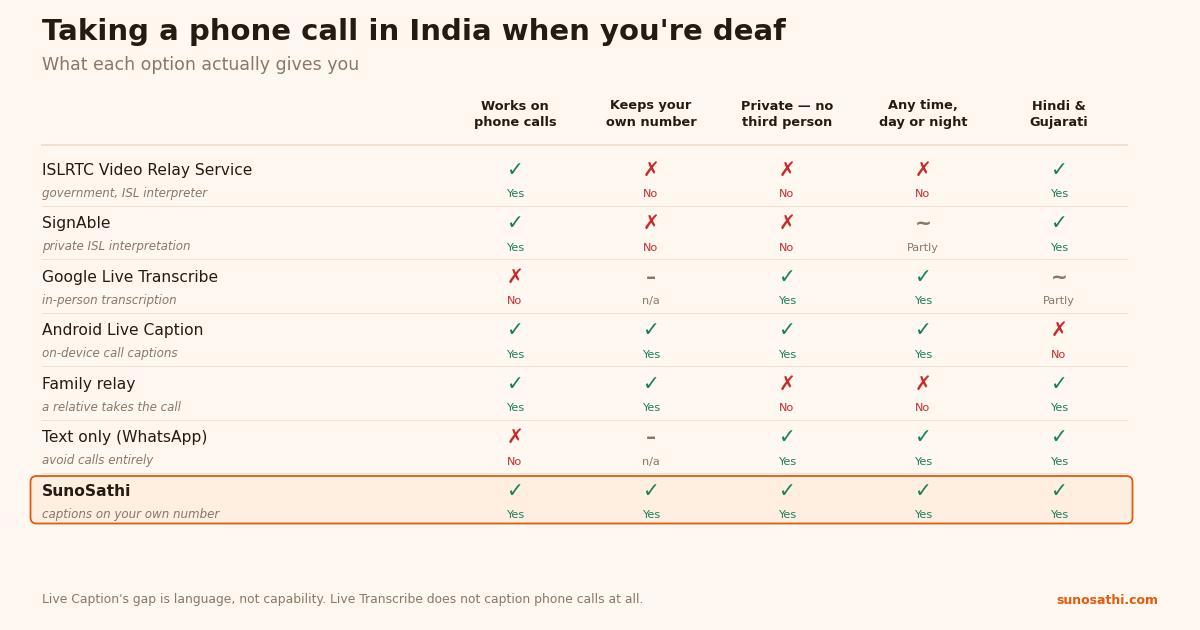
| Option | What happens on a call | Your own number? | A third person on the call? | When you can use it | Cost |
|---|---|---|---|---|---|
| ISLRTC Video Relay Service (government) | You video-call an ISL interpreter, who speaks to the other person for you | No — you call the VRS helpline | Yes — an interpreter | Mon–Fri, 9am–5pm only | Free |
| SignAble (private VRI) | Same model, commercial: ISL interpreter relays into one of 13 languages | No | Yes — an interpreter | Longer hours, subscription-based | Paid, from around ₹99 |
| Google Live Transcribe | Transcribes people talking near you | — | No | Anytime | Free |
| Android Live Caption | Captions audio on your device, including calls | Yes | No | Anytime | Free |
| Family relay | A hearing relative takes the call and tells you what was said | No | Yes — your relative | Whenever they're free | Free |
| Text only | You refuse calls and ask for WhatsApp | — | No | Anytime | Free |
| SunoSathi | Your own number rings in an app; you read live captions and reply by voice, typing, or picture tiles | Yes | No | Anytime, day or night | Free during the pilot |
Three things in that table decide most people's answer: whether you keep your own number, whether a stranger hears your call, and whether it works at 9pm on a Sunday.
Where each one genuinely wins
Use ISLRTC VRS when you need nuance in ISL. A government office, a legal matter, a complicated hospital conversation — a trained human interpreter understands Indian Sign Language in a way no software does. It is free, it is official, and the helpline is 8929667579.
Its limit is arithmetic, not attitude. India has roughly 4.5 million ISL users and about 1,000 certified interpreters. The service runs Monday to Friday, 9am to 5pm. Your landlord does not call during office hours.
Use SignAble when you want interpretation with less waiting and are willing to pay for it. It was India's first video remote interpretation service and it covers 13 languages.
Do not rely on Google Live Transcribe for phone calls. This is the single most common mistake, and it is worth being blunt: Live Transcribe does not caption phone calls. It transcribes speech in the room around you. It is excellent for a shop counter or a classroom. On a call, it does nothing.
Android's Live Caption is the one that *does* caption calls, on-device. It is genuinely useful if you speak English. Its Indian-language coverage is thin, it does not follow a speaker who switches from Hindi to English mid-sentence — which is how most of India actually talks — and it has no way to speak for you if you cannot use your voice.
Family relay works, and it costs you something real. Every bank balance, every medical result, every argument with a relative passes through another person. Many deaf adults describe this as the hardest part of the whole situation: not the silence, the loss of privacy. यह सबसे बड़ी बात है — आपकी बात आपकी ही रहनी चाहिए.
What "captions on your own number" actually means
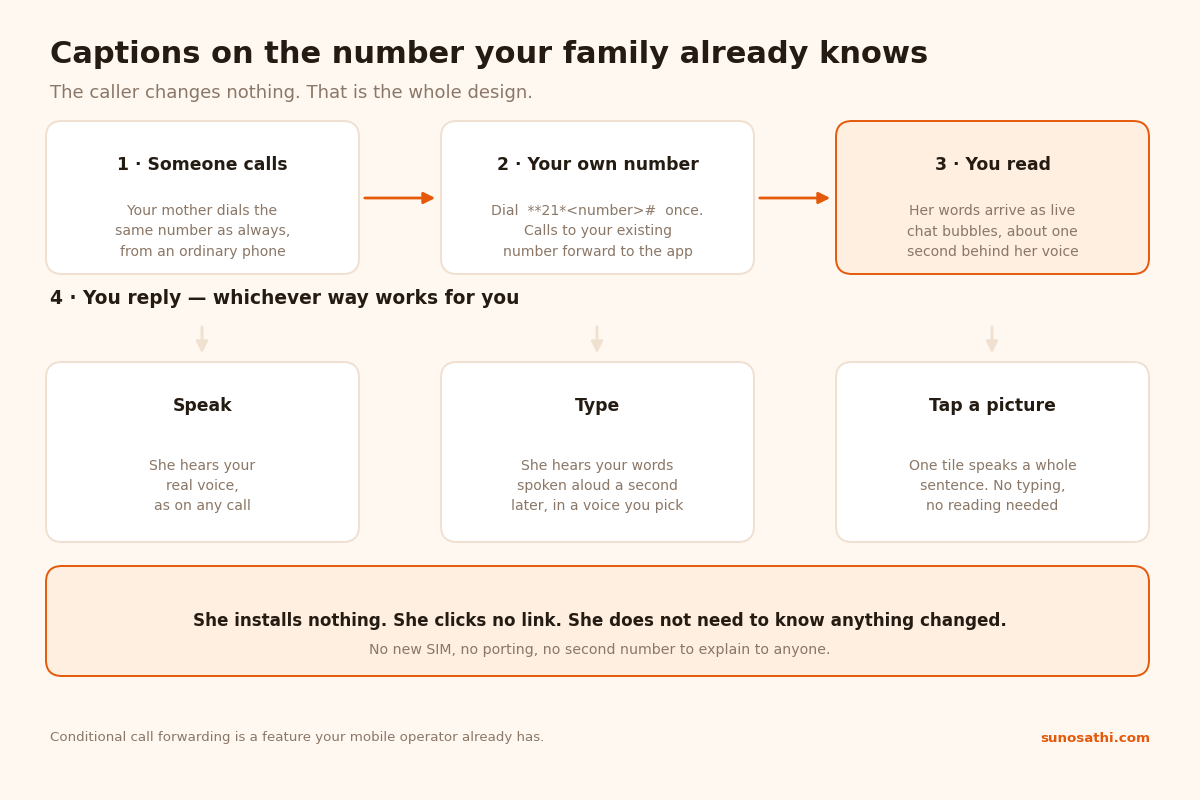
This is the part that sounds impossible, so here is the mechanism plainly.
Your mobile operator already has a feature called conditional call forwarding. You dial one code — it looks like **21*<number># — once, from your own phone. From then on, calls to the number your family already knows ring inside a captioning app instead of your dialer.
Nothing changes for the person calling you. Your mother dials the same number she has always dialled, from her ordinary phone, and talks normally. She installs nothing. She clicks no link. She does not need to know anything has changed.
Inside the app, her words arrive as chat bubbles, roughly a second behind her voice. You reply in whichever way suits you:
- Speak, and she hears your real voice.
- Type, and she hears your words spoken aloud a moment later — in a voice you
choose. While you type, she is automatically told to hold on, so she doesn't hang up.
- Tap a picture, and a whole sentence is spoken for you. No typing, no
reading required. This is built for people whose first language is ISL.
That third option matters more than it looks. Every other service on this page assumes you either sign to an interpreter or speak with your own voice. If you do neither, they have nothing for you.
SunoSathi works this way, and it is what we build. It is free during our pilot — we want feedback, not money. If you want to see the real screens before deciding anything, the step-by-step guide walks through it in Hindi, and iPhone users can install from the App Store.
We will also say the unglamorous part: automatic captions are not perfect. Accuracy sits between 81% and 95% on natural speech, and we score every call and publish the range rather than the best number. A human interpreter is more accurate than that. What you get instead is your own number, no third person listening, and a phone that works at midnight.
How to choose, in one line each
- You sign ISL and need a difficult official conversation → ISLRTC VRS.
- You need interpretation outside office hours and can pay → SignAble.
- You need to take ordinary calls, anytime, on your own number → a captioned
calling app.
- You cannot use your voice at all → you need type-to-speak or picture
replies specifically.
- You only speak English and own a recent Android → try Live Caption first.
It's already on your phone.
Most people end up using two of these, not one. That is the correct answer, not a compromise.
Why this is a 63-million-person problem
The World Health Organization estimates that about 63 million Indians live with significant hearing impairment — around 6.3% of the population. Roughly 18 million are deaf.
Those numbers describe different groups and it is worth keeping them apart: the 63 million includes everyone from a grandmother who misses half of what the TV says to a person who has never heard sound.
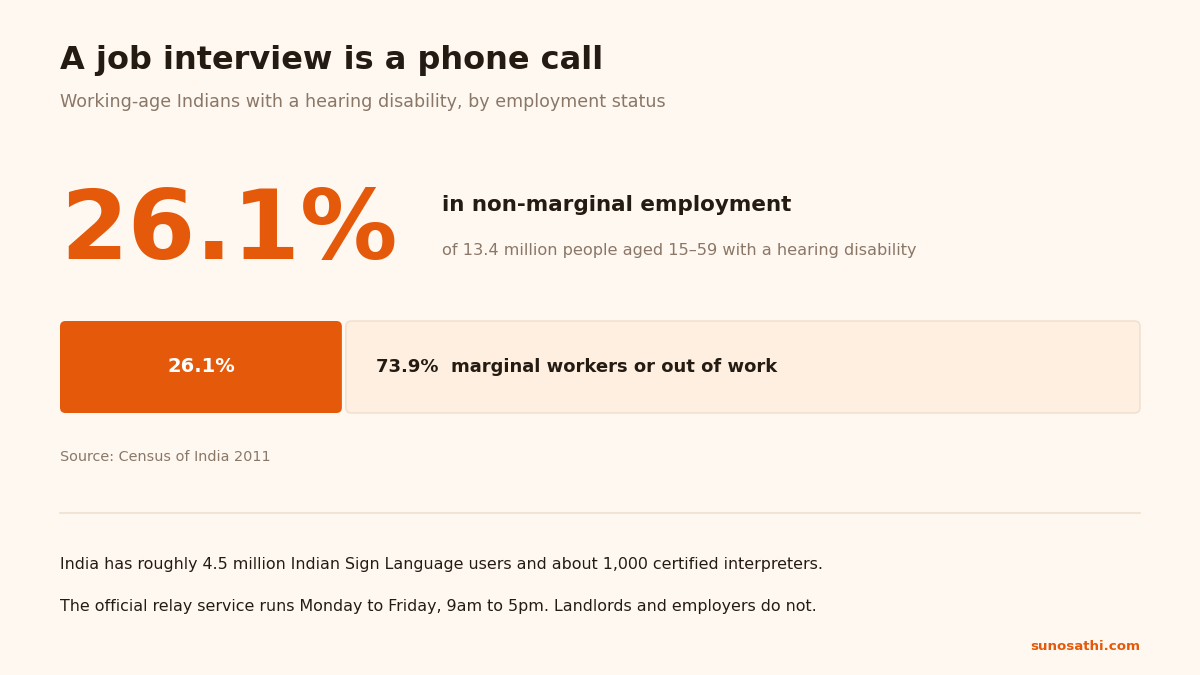
The consequence shows up in work. Census 2011 counted 13.4 million people aged 15 to 59 with a hearing disability — and found only 26.1% of them in non-marginal employment. A job interview is a phone call. A delivery job is a phone call. A landlord is a phone call.
Frequently asked questions
Can a deaf person make phone calls in India?
Yes. There are four working approaches: an ISL interpreter via video relay service, a captioned calling app that shows the caller's words as live text, a hearing person relaying the call, or moving the conversation to text. Which one fits depends on whether you sign, whether you can use your voice, and whether you need calls outside office hours.
Is there a captioned calling service in India?
Yes, though the category is new here. The well-known captioned-phone services — CaptionCall, InnoCaption, Sorenson — are funded by the US FCC and do not operate in India. Indian options include captioned calling apps such as SunoSathi, which delivers live captions on your existing mobile number.
Does Google Live Transcribe work on phone calls?
No. Live Transcribe transcribes speech happening around you, not call audio. The Android feature that *can* caption calls is Live Caption, which is different and works on-device — but its Indian-language support is limited.
What is the ISLRTC Video Relay Service and when can I use it?
It is the Indian government's free video relay service, run by the Indian Sign Language Research and Training Centre. You video-call an ISL interpreter who speaks to the other person on your behalf. The helpline is 8929667579, available Monday to Friday, 9am to 5pm.
Can I keep my own mobile number?
Yes, with a captioned calling app that uses call forwarding. You dial one forwarding code once from your own phone; after that, calls to your existing number ring in the app. There is no new SIM, no porting, and nothing for the person calling you to change or install.
Do people calling me need to install anything?
No. They dial your normal number from any ordinary phone and speak normally. This is the difference between captioned calling and a video-call app — with a video app, both sides must be on it.
I can't speak. Can I still use a phone call?
Yes, but you need a service built for it. Type-to-speak turns what you type into a spoken voice the caller hears. Picture-tile replies speak a whole sentence when you tap an image, which needs no typing or reading. Interpreter-based relay services assume you sign; on-device caption tools assume you speak.
Are automatic captions accurate enough for something important?
For everyday calls, yes. For a legal or medical conversation where a misheard word changes the outcome, a human ISL interpreter is still more reliable. Automatic caption accuracy on natural Indian speech typically runs between 81% and 95%, and it drops in heavy background noise.
Is it free?
ISLRTC VRS is free. Live Caption and Live Transcribe are free. SignAble is a paid subscription starting around ₹99. SunoSathi is free during its pilot.
If you want to try this
We are onboarding deaf and hard-of-hearing users, families, NGOs and interpreters right now, one at a time, personally. It is free during the pilot.
If you sign ISL and want to help build the picture-tile vocabulary, we would rather learn it from you than guess: contribute ISL.
And if a different option on this page is the right one for you, use that one. The point is that you get to answer the phone.
Free during the pilot. We want feedback, not money.
Join the SunoSathi pilot